Ecofeminism in the Mediterranean
The Mediterranean Ecofeminism Circle is a transnational platform of ecofeminist activists and collectives organizing political collective action for anti-colonial solidarity across the Mediterranean region.
The Circle aims to build a regional ecofeminist alliance and agenda for a post-growth transition.
It brings together influential degrowth-aligned ecofeminist activists from across the Mediterranean in order to present, discuss and learn about each other’s feminist and climate justice struggles in the region. Through the regular gathering of activists in a safe facilitated space, the Circle aims to enable the identification of common but differentiated struggles, on the basis of which to draw a collective regional agenda for a just transition to a post-growth society that organises economic activity in order to guarantee a healthy, decent life for all, and that tackles patriarchal, neocolonial, racist and capitalistic structures of oppression.
The Trans-Mediterranean Fund
Since October 2023, the Israeli military campaign in Lebanon has caused widespread destruction and displacement.
Documented impacts include:
- 10,000+ civilian structures destroyed
- 2,154 hectares of farmland damaged
- Health workers and journalists targeted
- 1 million+ people displaced
- 4,000+ people killed
- 64,000+ unable to return home
Beyond human suffering, the bombardment has damaged ecosystems, polluted air and water, and undermined public health and local livelihoods.
Why this fund?
We created the Trans-Mediterranean Fund to channel solidarity and material support from across the Mediterranean to communities in Southern Lebanon.
Our ecofeminist perspective
We understand ecofeminism as a politics that connects people, land, and nature, while resisting imperialist and capitalist systems that colonize lands and peoples, exploit the Earth and devalue reproductive and care labour.
Where do donations go?
The Trans-Mediterranean Fund redistributes resources to three grassroots mutual-aid initiatives working directly with affected communities for mutual aid and ecological restoration.
These three mutual aid fundraisers are:
✺ Palestinian refugee camps in South Lebanon fundraiser
This fundraiser supports relief efforts led by Palestinian organizers in Lebanon, responding to the mass displacement affecting Palestinian refugee camps and surrounding communities.
Donations help provide: food parcels, baby milk and diapers, clothing, medicines, support for emergency responders.
Funds also contribute to sustaining community-based relief networks and equipping civil defense teams with essential protective and medical supplies.
✺ First responders
Grassroots fundraising to equip Lebanon’s national first responders – The Civil Defense (الدفاع المدني) with essential and life-saving supplies.
✺ Lebanon Emergency Relief
This initiative supports comrades displaced from Southern Lebanon and the suburbs of Beirut who have been forced to leave their homes.
Donations contribute to the distribution of: food, medicines, mattresses and blankets, clothing, essential household supplies.
The fundraiser helps meet urgent needs while supporting community-led networks of solidarity and care.
VOICES ACROSS WATERS
The podcast
Voices Across Waters is a living chain of conversations among ecofeminist activists from across the Mediterranean: Svetlana Balovska Đurković, Mariona Bonsfills Clotet, Noe Diaferia, Asmaa Elmalky, Simona Getova, Jasmina Husanović, Lena Penšek, Roula Seghaier, and Shereen Talaat. Through intimate and courageous dialogue, the series amplifies voices, stories, and political imagination rooted in care, solidarity, resistance, and transformation.
Across borders and struggles, each episode explores how ecofeminism challenges patriarchal, colonial, capitalist and extractivist systems while nurturing collective alternatives grounded in justice, dignity and ecological balance.
These are not just interviews. They are acts of alliance building towards collective liberation. They are conversations between commrades, between friends. They are hope.
This podcast series is part of the Ecofeminism in the Mediterranean initiative and was developed as a chain-interview format designed to create relational dialogue across territories, experiences, and struggles.
An initiative by Research & Degrowth International:
Research & Degrowth is an academic association dedicated to advancing research, training, and collective reflection on degrowth, ecological justice, and post-growth transformations. Through interdisciplinary collaboration, it supports critical thinking and collective action toward socially just and ecologically viable futures. Project coordination and leadership by Lena Penšek, activist and communicator of the Ecofeminism in the Mediterranean project, with visual identity and artwork by Alexandra Mestre Garcia. Find out more at https://degrowth.org/
Design and production by Efecto Colibrí:
Efecto Colibrí helps create narratives that advance a just, diverse, and regenerative reality. It drives systemic change by transforming the stories that quietly shape our worlds. Through narrative research, co-design of systemic-change narratives, and story activation, Efecto Colibrí builds understanding, moves conversations forward, and equips teams to create change through narrative clarity in times of noise and polarization. Creative design by Ana Amrein, founder of Efecto Colibrí, together with Gonzalo Díaz, architect and editor. Find out more at: https://efectocolibri.com/en/
If this conversation resonates with you, share it and help these voices travel further across the Mediterranean and beyond.
Read the detailed descriptions of every episode:
Ep. 1: Me, you and the revolution
In this episode of Voices Across Waters, Shereen speaks with Simona about growing up in post-Yugoslav Macedonia, inheriting a deep sense of social justice, and finding her political home in transnational climate justice organizing.
Simona reflects on a defining moment within international climate justice organizing, when comrades from the Global South challenged European activists to confront privilege, colonial histories, and unequal power relations within the movement itself. From that turning point, intersectionality became not a theory, but a practice.
Together, they explore why relationships are the foundation of ecofeminist struggle, why “safe spaces” must go beyond rhetoric, and how solidarity must become material through mutual aid, shared platforms and tangible care. In a world shaped by late-stage capitalism, militarization and patriarchal elites, this conversation reminds us that prefiguring the future begins in how we relate to one another now.
Simona Getova (interviewee) is an intersectional decolonial feminist organizer, facilitator, and educator from Macedonia, currently based in Barcelona. Simona is the head of operations at Research & Degrowth International and a researcher at the Department of Political and Social Sciences at UPF.
Shereen Talaat (interviewer) is a feminist economist and filmmaker from Egypt, currently based in Marocco, who founded the MENAFEM Movement to lead regional advocacy for debt justice and feminist economic alternatives in the SWANA region.
Ep. 2: Grieving together, resisting together
In this deeply personal episode, Noe speaks with Simona about feminist awakening, collective grief, and the revolutionary power of relationships.
Noe shares how the public naming of femicide as systemic patriarchal violence in Italy became a turning point in her activism, leading to the creation of a grassroots feminist movement. Together, they reflect on grief ceremonies as collective healing practices and on how community-building directly challenges capitalist individualism.
Drawing on Chimamanda Ngozi Adichie’s idea of “the danger of a single story,” they explore why storytelling is central to ecofeminist struggle — and how breaking dominant narratives opens space for dignity, complexity, and solidarity across the Mediterranean.
Noe Diaferia (interviewee) is a transfeminist activist from Southern Italy. They are active in the nonviolent civil resistance movement Bruciamo Tutto (Let’s Burn Everything) advocating for radical systemic change and social justice.
Simona Getova (interviewer) is an intersectional decolonial feminist organizer, facilitator, and educator from Macedonia, currently based in Barcelona. Simona is the head of operations at Research & Degrowth International and a researcher at the Department of Political and Social Sciences at UPF.
Ep. 3: Building together beyond our differences
In this episode, Noe interviews Asmaa, an environmental lawyer and feminist researcher from Egypt, about ecofeminism as a systemic alternative to patriarchy, neoliberal exploitation, and colonial power.
Asmaa reflects on the layered realities of Egypt, urban and rural, Mediterranean and African, and how ecofeminism must be shaped by local communities rather than imposed as a universal solution. Together, they discuss borders, political repression, solidarity under occupation, and the importance of centering Palestinian struggles within Mediterranean activism.
This conversation is both intimate and political. It’s a reminder that solidarity is not about speaking for others, but about listening, amplifying and building resilient communities beyond our differences.
Asmaa Elmalky (interviewee) is a feminist environmental lawyer from Egypt. She holds a Master’s degree in International and Comparative Law from the American University in Cairo and is the head of the research department at the Egyptian Foundation for Environmental Rights.
Noe Diaferia (interviewer) is a transfeminist activist from Southern Italy. They are active in the nonviolent civil resistance movement Bruciamo Tutto (Let’s Burn Everything) advocating for radical systemic change and social justice.
Ep. 4: Ecofeminism as a project of economic democracy
In this episode, Asmaa speaks with Mariona about ecofeminism as a project of economic democracy, collective emancipation, and degrowth transformation. From growing up on an organic farm in the Catalan Pyrenees to organizing within labor and political advocacy spaces, Mariona reflects on how feminism reshaped her understanding of value, labor, and whose voices count in history.
They discuss reclaiming sidelined memories of women during the Spanish Civil War, challenging the myth of endless economic growth, and confronting the narrative that “there is no alternative” to capitalism. Together, they argue that feminism and ecology are not side issues but are central to restructuring economies around the maintenance of life.
This conversation is a call for mass participation, transnational organizing, and the radical belief that everyone, regardless of background, is a legitimate political actor.
Mariona Bonsfills Clotet (interviewee) is an ecofeminist researcher, labour unionist and organiser from Catalonia. She is part of Research and Degrowth International, and an activist on ruralism and the transition toward an ecosocialist future.
Asmaa Elmalky (interviewer) is a feminist environmental lawyer from Egypt. She holds a Master’s degree in International and Comparative Law from the American University in Cairo and is the head of the research department at the Egyptian Foundation for Environmental Rights.
Ep.5: Ecofeminism in the Western Balkans
In this episode, Mariona speaks with Jasmina about ecofeminism emerging from the wounds of war, neoliberal transition, and extractivist violence in Bosnia and Herzegovina.Jasmina traces her journey from feminist peace activism during the 1990s war to co-founding a national ecofeminist platform connecting nearly 30 organizations across the country. Together, they unpack how environmental destruction, energy poverty, toxic waste, and so-called “green transition” projects turn the Western Balkans into a sacrifice zone for global capital.
The conversation explores environmental democracy, radical municipal assemblies, the crisis of social reproduction, and the urgent need for sustained, face-to-face solidarity across the Mediterranean. At its heart, this episode is about rebuilding trust and defending society itself in a time of authoritarian capitalism.
Jasmina Husanović (interviewee) is an activist, a scholar and a professor from Bosnia and Herzegovina and a founder of the EKOFEM BiH platform, working on the politics of the commons and emancipatory social transformation.
Mariona Bonsfills Clotet (interviewer) is an ecofeminist researcher, labour unionist and organiser from Catalonia. She is part of Research and Degrowth International, and an activist on ruralism and the transition toward an ecosocialist future.
Ep. 6: Activism of everyday life on an island
In this intimate and reflective conversation, Jasmina speaks with Svetlana about ecofeminism as a lived, daily practice rooted in care, resilience, and intergenerational responsibility.
From feminist awakening in childhood to LGBTQI+ activism and motherhood, Svetlana –reflects on how raising a daughter deepened her ecological consciousness. Now living on a Mediterranean island, she shares how ecofeminism manifests through community education, soil regeneration, rainwater collection, composting, and protecting the sea from plastic pollution.
Together, they explore trust within activist spaces, the importance of preventing burnout, and why joy and love are not luxuries but necessary political forces. This episode reminds us that transformation begins close to the ground, in the air we breathe and the water we protect.
Svetlana Balovska Đurković (interviewee) is an anthropologist and ecofeminist queer activist from Bosnia and Herzegovina and the United States. Currently based in Croatia, she is a pioneer of the LGBTIQ+ movement in Bosnia and Herzegovina, now dedicating her efforts to environmental justice.
Jasmina Husanović (interviewer) is an activist, a scholar and a professor from Bosnia and Herzegovina and a founder of the EKOFEM BiH platform, working on the politics of the commons and emancipatory social transformation.
Ep. 7: Women are going to save the world, right mom?
In this episode, Lena reflects on ecofeminism as both a lens and a lived practice one that connects patriarchy, capitalism, knowledge, and care. From her early political awakening to climate justice organizing in Slovenia and Barcelona, Lena traces how ecofeminism expanded her activism beyond single-issue struggles toward confronting broader systems of oppression.
Together, the conversation explores autonomous women’s spaces, unpaid care labor, trust-building, and the radical power of storytelling. They reflect on the Mediterranean as both bridge and border: a sea of olive trees and tourism, but also of migration, climate crisis, and political fracture.
At its heart, this episode is a call to transform hopelessness into collective action, to build spaces where care fuels resistance.
Lena Penšek (interviewee) is a Slovenian activist and feminist, currently based in Barcelona. She organizes in the intersection between climate and social justice, transnational organising, degrowth, solidarity and feminism.
Svetlana Balovska Đurković (interviewer) is an anthropologist and ecofeminist queer activist from Bosnia and Herzegovina and the United States. Currently based in Croatia, she is a pioneer of the LGBTIQ+ movement in Bosnia and Herzegovina, now dedicating her efforts to environmental justice.
Ep. 8: The Power of Transnational Solidarity
n this episode of Voices Across Waters, Lena interviews Roula about growing into feminism intuitively and understanding ecofeminism through lived realities of militarization, migration, and community memory.
Roula reflects on how feminist consciousness often begins as a feeling, a quiet refusal of injustice, and expands into collective struggle. Together, they explore how militarized borders, forced migration, and extractive systems disproportionately shape women’s lives across the Mediterranean.
From ancestral memory to transnational solidarity, this conversation reminds us that shifting narratives requires trust, vulnerability, and deep listening. In a world shaped by imperialism and capitalism, building relationships becomes an act of resistance, an act of hope.
Roula Seghaier (interviewee) is a Tunisian interdisciplinary writer and organizer in migrant rights, labor justice and intersectional feminism. She is currently based in New York City and serves as the International Coordinator of the Women in Migration Network (WIMN).
Lena Penšek (interviewer) is a Slovenian activist and feminist, currently based in Barcelona. She organizes in the intersection between climate and social justice, transnational organising, degrowth, solidarity and feminism.
Ep. 9: Ecofeminism and the fight for justice
In this final episode of Voices Across Waters, Roula speaks with Shereen Talaat. Rooted in the experiences of the SWANA region, Shereen unpacks ecofeminism as a struggle over power: who controls resources, who bears the cost, and whose lives are valued.
From debt and climate injustice to colonial legacies and global financial systems, she calls for a feminism that is unapologetically political, anti-colonial and grounded in lived realities. This conversation is a call to move beyond symbolic solidarity and into material action through accountability, shared struggle, and collective power.
It is also a reminder that narratives shape reality, and that reclaiming our stories is part of building alternatives. And through it all, one thing remains essential: hope, not as optimism, but as responsibility.
Shereen Talaat (interviewee)is a feminist economist and filmmaker from Egypt, currently based in Marocco, who founded the MENAFEM Movement to lead regional advocacy for debt justice and feminist economic alternatives in the SWANA region.
Roula Seghaier (interviewer)is a Tunisian interdisciplinary writer and organizer in migrant rights, labor justice and intersectional feminism. She is currently based in New York City and serves as the International Coordinator of the Women in Migration Network.
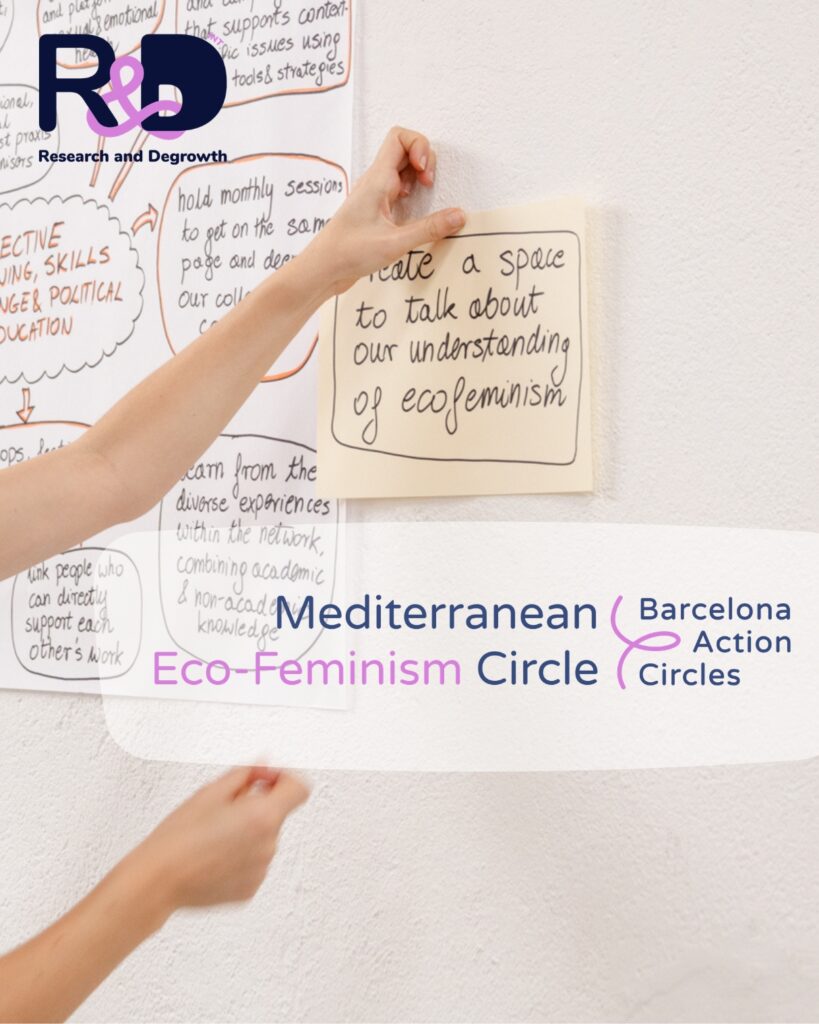
Our definitions, principles and strategies
The Ecofeminism in the Mediterranean circle organises around…
How we understand:
- Ecofeminism
- The Mediterranean
- Degrowth
The principles we work with:
- Inclusive and accessible community
- Culture of care and trust
- Collective action and solidarity
Our strategic goals and objectives:
- Collective learning, skills exchange & political education
- Transnational solidarity & coordinated action
- Emotional, mutual support & political depth
Funded by