
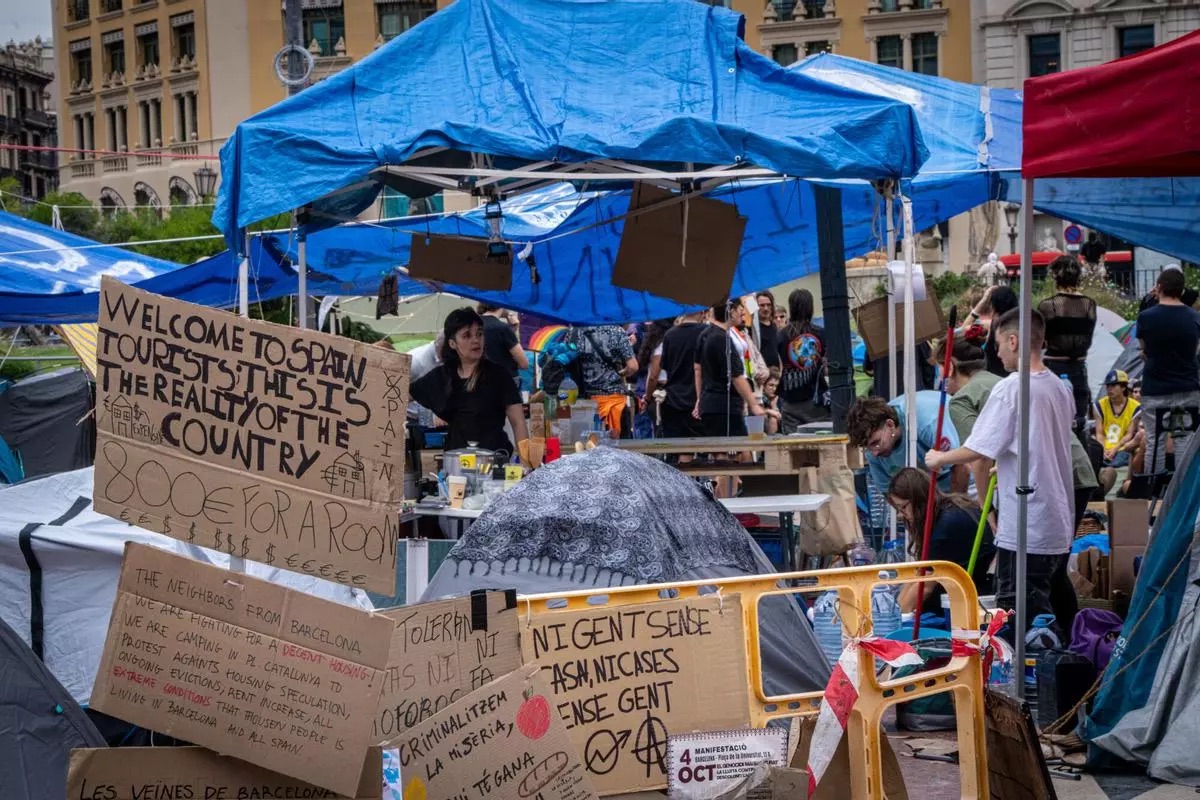
Encampment for housing in Barcelona. Photo: Manu Mitru | el Periódico
Research & Degrowth International (R&Di) would like to express our support for the encampment in Plaza Catalunya (Barcelona) and other cities in Spain and for the struggles that converge within it. We invite students, student associations, collectives, faculties and university communities to join, participate and make this space a place for meeting, learning and organising.
We encourage universities to leave their classrooms and engage with the city: to organise public classes, debates, workshops, seminars and other activities at the encampment; to put knowledge at the service of social struggles and to open spaces where universities and society can think and act together.
R&Di also expresses its support for the general strike and calls on our friends and comrades, and on the alliances we have built within universities, the trade union movement and social movements, to actively contribute to building it.
A general strike is not simply declared: it is organised. We therefore invite those who share these struggles to take initiative, to meet in workplaces and places of study, to join associations and neighbourhood networks defending housing and life, and to work from now on to make a strong, broad and territorially rooted general strike possible.
The history of workers’ struggles reminds us that the collective organisation of work has been a way of winning time and space for life, for self-management and for social transformation. The reduction of working hours, the weekly day of rest, paid holidays and other rights were not spontaneous concessions: they were victories won through decades of organisation, mobilisation and strikes.
What is the point of producing more if we do not have time to live, care for one another, organise and participate in collective life? A just transition cannot be limited to changing technologies or energy sources: it must also transform the relationship between work, time, consumption and life.
We oppose the conception of the city as a mere “growth machine”: an economic machine oriented towards attracting capital, increasing land values, expanding tourism and turning an ever-growing share of everyday life into financial assets.
When housing becomes a commodity and the city becomes a vehicle for accumulation, those who live, study and work there are progressively displaced from their own neighbourhoods. Rising rents, real-estate speculation, touristification and the financialisation of housing are all part of an urban model that prioritises economic interests over the needs of those who inhabit the city.
Against this, from a degrowth perspective, we ask:
Spain is growing, but for whom?
The Spanish economy has been presented in recent years as a European success story. This growth is real.Curiously, however, the country has grown through the creation of many precarious jobs—in sectors that do not contribute to well-being—and with poverty-level wages. But precisely for this reason, we need to ask: what does growth mean, and who benefits from it?
GDP measures the monetary value of what is produced, but not how it is distributed, who controls the assets whose value is increasing, who can access housing, or how much time remains for living. An economy can grow while generating very different experiences depending on people’s social position.
Housing makes this tension visible. While the economy grows, housing prices continue to rise sharply and affordable supply is not keeping pace with the creation of new households. In many cities, people who work there are finding it increasingly difficult to afford to live there.
This forces us to look beyond aggregate growth: can a city be considered an economic success when economic activity and property values increase while the people who sustain the city are being displaced from their neighbourhoods?
The manifesto Housing (for) a Post-Growth World, developed in the context of the 2025 International Degrowth and Ecological Economics Conference in Oslo, argues that today’s housing crises are closely linked to a model that treats housing as a commodity and real-estate development as an engine of growth. The manifesto proposes four major shifts:
1. Transform dominant narratives around housing: homes should be understood as spaces of care, belonging and collective well-being, rather than simply as properties.
2. Free housing from market pressures, expanding public, cooperative, community-based and collective forms of access and ownership.
3. Move beyond a housing policy based primarily on building ever more homes, and instead focus on a fairer distribution of the existing housing stock, its renovation, accessibility and environmental performance.
4. Understand housing as a broader social infrastructure, encompassing public spaces, services, facilities, mobility, care and community networks that make collective life possible.
Rather than asking how to increase construction, property values or the competitiveness of our cities, a degrowth housing policy asks a different question: how can we guarantee dignified housing for everyone while reducing speculation, ecological pressures and the commodification of our cities?
The fundamental question, then, is not how much a city grows, but who it grows for, who can afford to live there, and what kind of community we want to build.
We therefore call on students, workers, trade unions, housing collectives, associations, social movements and university communities to come together, organise and build the conditions for an ecosocial and degrowth transformation.Sha
For territories at the service of life, not economic growth.
Research & Degrowth International (R&Di)